


PlayTime (2026)
Upcoming exhibition at Gallery Deborah Schamoni,
Munich- Various others
16.05. – 24.05.2026
It is only since the advent of industrial glass production in the early 20th century that it became possible to produce glass free of inclusions and ripples. This technological development enforced the phantasma of glass as a fully transparent and ‘pure’ medium that can easily make any consciousness of its materiality disappear. It also set the path for the use of glass in the endless series of screens that shape our contemporary reality: modern life is a life through glass.
However, while utopists like Paul Scheerbart used to envision an ornamental, colorful, and even warm Glasarchitektur (1914) that could rival the lushest gardens, the aesthetic reality of 20thcentury everyday life all too often turned out to be nothing but minimalist, gray, and cold. In his comedy PlayTime (1967), the French director Jacques Tati uses this sterile Modernist sensibility as the backdrop for a playful dramaturgy of chance and chaos. Time and again, his characters bump against invisible doors to either break their own noses or shatter these delicate objects into pieces.
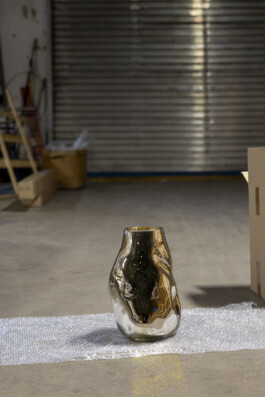
Echoing the title of Tati’s film, Katharina Ruhm’s series PlayTime showcases a set of ten mirrored glass vases with a special focus on their amorphous material quality. Produced with artisanal craftsmanship, the manual production processes are imprinted into the texture of the objects. The curved and bulging surfaces of the vases do not so much reflect their surroundings as distort them. In their own beautiful way, the objects of this limited-edition demonstrate the morphing and even obscuring effects that mirrored glass can have — and draw the ideology of transparency into a shimmering vortex of chrome.
Text by Jan Lietz
Photo by Maidje Meergans
© 2016 — 2024 Katharina Ruhm
PlayTime (2026)
Upcoming exhibition at Gallery Deborah Schamoni,
Munich- Various others
16.05. – 24.05.2026
It is only since the advent of industrial glass production in the early 20th century that it became possible to produce glass free of inclusions and ripples. This technological development enforced the phantasma of glass as a fully transparent and ‘pure’ medium that can easily make any consciousness of its materiality disappear. It also set the path for the use of glass in the endless series of screens that shape our contemporary reality: modern life is a life through glass.
However, while utopists like Paul Scheerbart used to envision an ornamental, colorful, and even warm Glasarchitektur (1914) that could rival the lushest gardens, the aesthetic reality of 20thcentury everyday life all too often turned out to be nothing but minimalist, gray, and cold. In his comedy PlayTime (1967), the French director Jacques Tati uses this sterile Modernist sensibility as the backdrop for a playful dramaturgy of chance and chaos. Time and again, his characters bump against invisible doors to either break their own noses or shatter these delicate objects into pieces.
Echoing the title of Tati’s film, Katharina Ruhm’s series PlayTime showcases a set of ten mirrored glass vases with a special focus on their amorphous material quality. Produced with artisanal craftsmanship, the manual production processes are imprinted into the texture of the objects. The curved and bulging surfaces of the vases do not so much reflect their surroundings as distort them. In their own beautiful way, the objects of this limited-edition demonstrate the morphing and even obscuring effects that mirrored glass can have — and draw the ideology of transparency into a shimmering vortex of chrome.
Text by Jan Lietz
Photo by Maidje Meergans
© 2016 — 2024 Katharina Ruhm